Start with basic information governance
How can you begin to work with information governance in your organization without make it an administrative nightmare?
My recommendation is that you start with a basic business glossary of business terms.
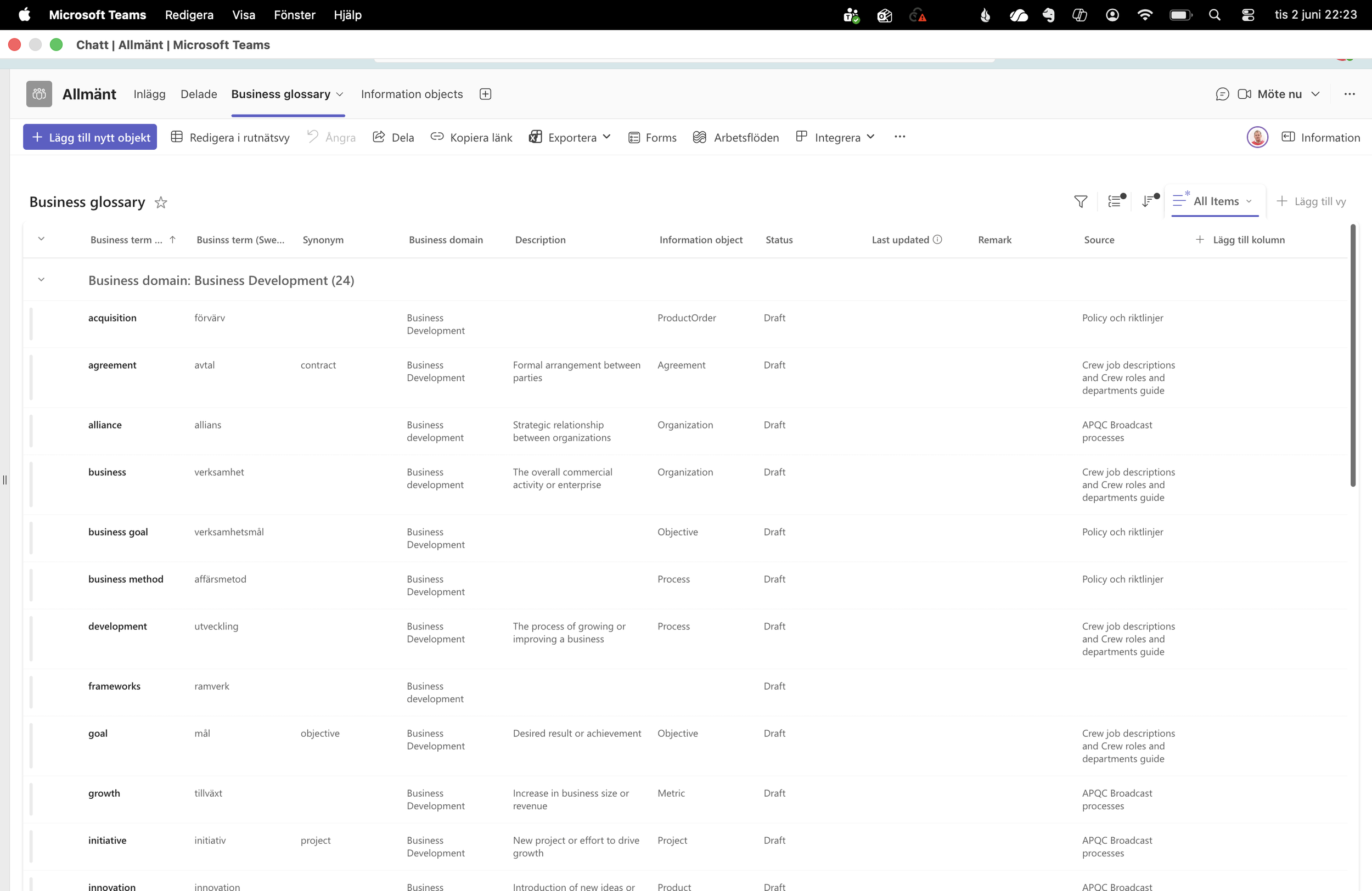
The example shows the glossary for Artmann Studio & Artmann Media, that I put up on our intranet last week. The list was created with help of AI, and the effort was limited.
Each term is associated with a business capability, and each of them should have a business owner and a data steward.
Next, when implementing governance, you also need to describe the processes used for governance.
To make it simple, I suggest three very basic process flows. 1. Add a new tem, 2. Change an existing term. 3. Revoke a term, make it depreciated.
Being lazy, I asked copilot to create an initial first process that let's everyone suggest a new term. See below.
The Principle: Anyone Can Suggest, Few Can Approve
A scalable glossary process must balance openness and control:
Anyone (employee, contractor, stakeholder) can propose a new term
Data Stewards ensure quality, structure, and consistency
Business Owners validate meaning and approve usage
This separation is critical:
Without openness → innovation stops
Without governance → chaos emerges
---
The Add Term Process (Operational Design)
Below is a structured, production-ready process that can be implemented directly in SharePoint with workflow support.
---
Step 1 — Submit Term Request
Actor: Requestor (employee, contractor, data steward, business owner)
The process begins when someone identifies a missing concept.
Required input:
Term name
Proposed definition
Business capability (context)
Requestor
The term is stored as a new item in the glossary list.
Status: Draft
👉 Design principle: Lower the barrier to entry. If capturing a term is difficult, it will not be done.
---
Step 2 — Triage and Deduplication
Actor: Data Steward
The first responsibility of governance is not enrichment—it is control.
The Data Steward:
Checks for existing terms or duplicates
Validates relevance within the business capability
Assigns ownership
Status: Under Review
👉 Design principle: A glossary without deduplication quickly becomes unusable.
---
Step 3 — Enrich and Structure the Term
Actor: Data Steward
At this stage, the term evolves from a suggestion into a managed information asset.
The Data Steward SHALL:
Refine the definition (clear, unambiguous, testable)
Add synonyms and related terms
Classify the term within a taxonomy
Map the term to information objects (e.g., SID entities, logical data objects)
This is where the glossary connects to your information architecture.
👉 Design principle: A term without structure is just text. A structured term becomes reusable knowledge.
---
Step 4 — Business Validation
Actor: Business Owner
The Business Owner validates that the term reflects real business meaning.
They SHALL:
Confirm the definition is correct and usable
Ensure alignment with business language and practice
Approve or reject the term
Status:
Approved
or Rejected
👉 Design principle: Only the business can define meaning. Architecture ensures structure—not semantics.
---
Step 5 — Publish the Term
Actor: System / Data Steward
Once approved, the term becomes an official part of the enterprise vocabulary.
The system SHALL:
Publish the term for all users (internal and external where relevant)
Assign version = 1.0
Set an effective date
Status: Published
👉 Design principle: If a term is not published and discoverable, it does not exist.